
ECO BATTERY
Games for Future v2: Solarpunk
A game about recycling car batteries has been developed. Through this entertaining game, people’s attention is drawn to the problem of disposing of large quantities of used car batteries. Due to the Chinese government’s support policies for electric vehicles, the market share of EVs in China has now risen to over 30%. However, if these batteries are not disposed of properly, they can pollute both water and soil. China is expected to experience the first major wave of end-of-life car batteries in 2025. To protect the environment, the recycling of car batteries must receive greater attention. The game aims to encourage players, in a positive and playful way, to think about how car batteries can be recycled.
My Role
Under the guidance of the course instructor, I independently completed the overall concept, design, and production of the project.
For the Unity development, I collaborated with a programmer who assisted with the technical implementation of the core mechanics.
My responsibilities included:
Concept ideation based on the course theme
Game flow and interaction structure
Visual identity and interface design
Asset creation in 2D
Audio design and integration
Coordinating the Unity implementation and handling content integration
Results
Delivered a fully playable mobile game prototype built with Unity.
Designed a distinctive game mechanic tailored for fast-paced hyper-casual gameplay.
Produced a short playtest demo video showcasing the core interaction loop.
Presented the project in the “Complex Design” course and received positive feedback from the instructor and classmates.
Platform
Eco Battery is a mobile game designed for both tablets and smartphones.
Tech Stack
Unity · Adobe Photoshop · Figma · Adobe Audition


M.A. Multimedia | VR Design
Supervisor: Prof. Jonas Hansen
Course: Complex Design
Summer semester 2024
Why Eco Battery
In this game, the term “battery” mainly refers to car batteries. In April of this year, Xiaomi presented a new car, which sparked a lot of discussion on the Chinese internet. At the same time, the entire electric-vehicle industry has been a major focus of attention. Thanks to a series of policy incentives from the Chinese government for new-energy vehicles, their market share in China has now exceeded 30%. Especially in my city, Shenzhen, new-energy vehicles can be seen everywhere. In the future, they will undoubtedly become the main means of transportation.
If old batteries are not disposed of properly, they can pollute both water and soil. Most new-energy vehicles in China are electric cars. When these cars are scrapped, a large number of used batteries are produced. If these batteries are not handled correctly, this could lead to a serious environmental catastrophe, which none of us wants to see.
China is expected to experience the first major wave of decommissioned car batteries in 2025. To protect the environment, the disposal of car batteries needs to attract much more attention. That is why I want to create a game about recycling batteries from new-energy vehicles. I hope that, through fun and engagement, the game will encourage players to think about car-battery recycling and become more aware of this issue.
How Car Batteries Are Recycled
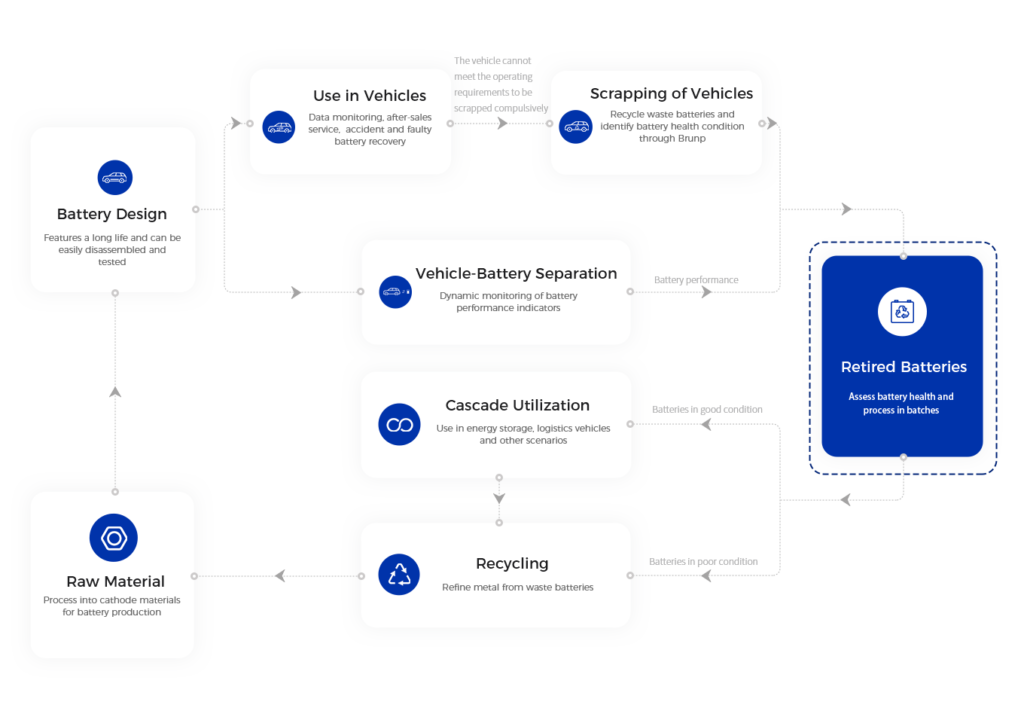
The graphic shows a battery recycling solution provided by a Chinese company called CALT. It also illustrates a future method for handling end-of-life car batteries. In simple terms, some of the retired car batteries are reused after evaluation, and the rest, which can no longer be reused, are actually recycled.
Image source: CALT (CATL).
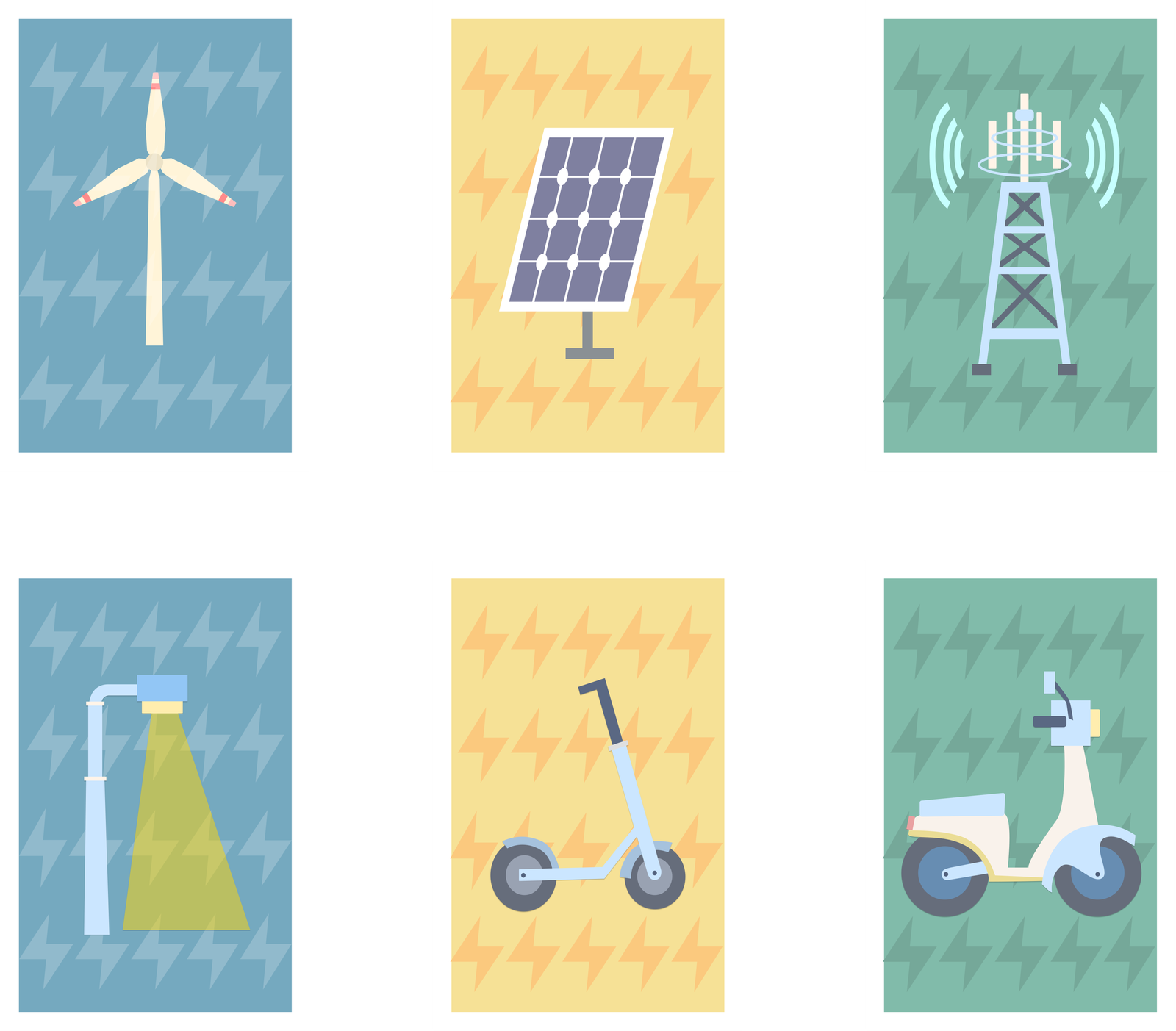
We refer to the reuse of batteries as “cascade use”. Old batteries that are found to be reusable after inspection are used in energy storage systems, emergency power supplies, and small vehicles. For example, wind turbines, base stations, and solar panels can all make use of old car batteries. The core gameplay of my game also focuses on this aspect of the cascade use of batteries.
Core Gameplay
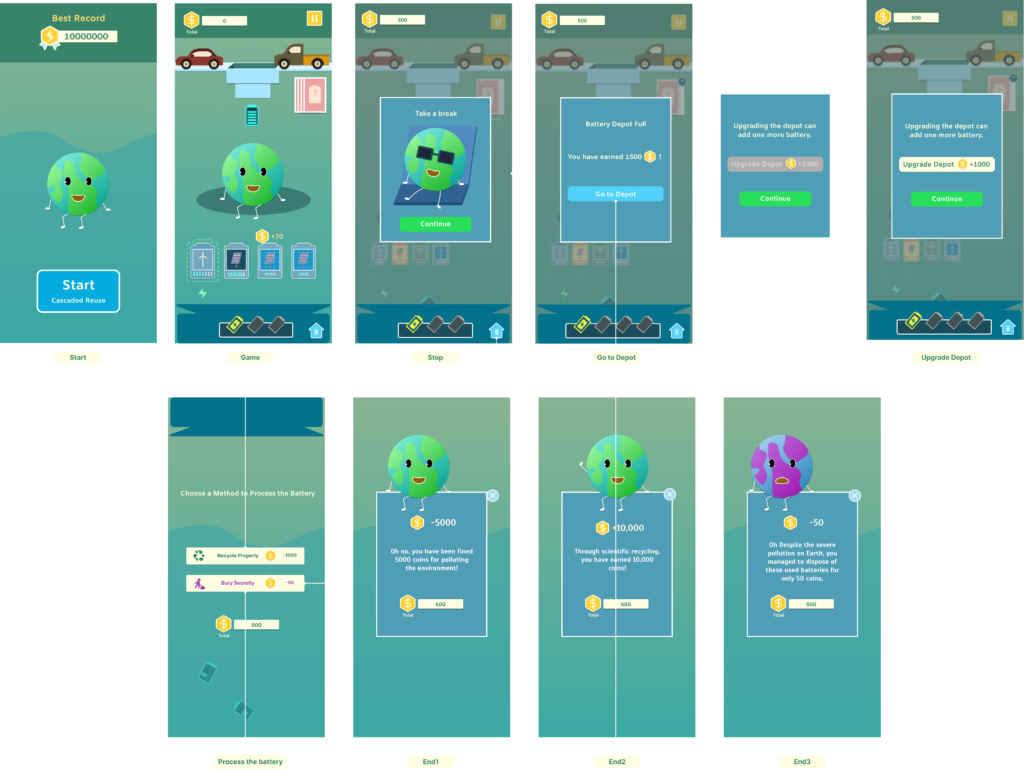
- Click “Start Cascaded Reuse” to begin recycling used car batteries.
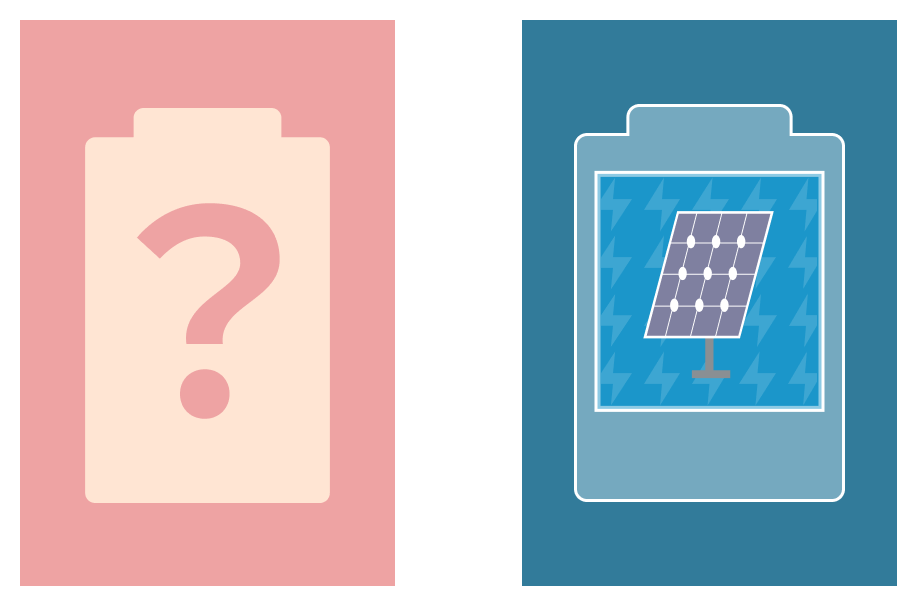
- The player must select cards to control where the battery will fall and add energy to the cascade reuse card stack. Once the current energy bar is full, the cascade reuse card stack disappears and the player receives coins. The game automatically reveals the next card and places it in the battery deck at the bottom. Cascade reuse is unlimited in each level.
- If the battery does not match the cascade reuse card, it falls into storage. At first, the storage can only hold three batteries, but the player can spend coins to increase its capacity.
- The game ends when the storage is full of batteries. The player can click a button to go to the storage area and process the old batteries stored there.
- The player can choose either to secretly refill the batteries or to recycle them properly in a scientific way. Different choices lead to different outcomes.
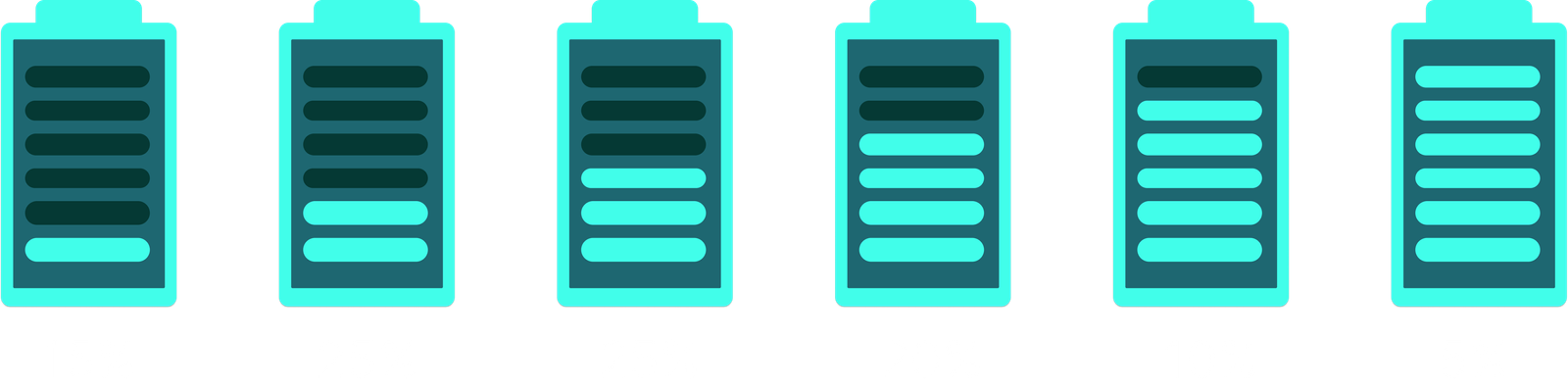
The energy capacity of the cascade-use cards ranges from 3 to 8, and each cascade-use card has a fixed capacity. The number of coins the player receives after charging a card is determined by the card’s energy fields. Each energy field represents 10 coins. For example, the player receives 30 coins when they fully charge a card with 3 energy fields.
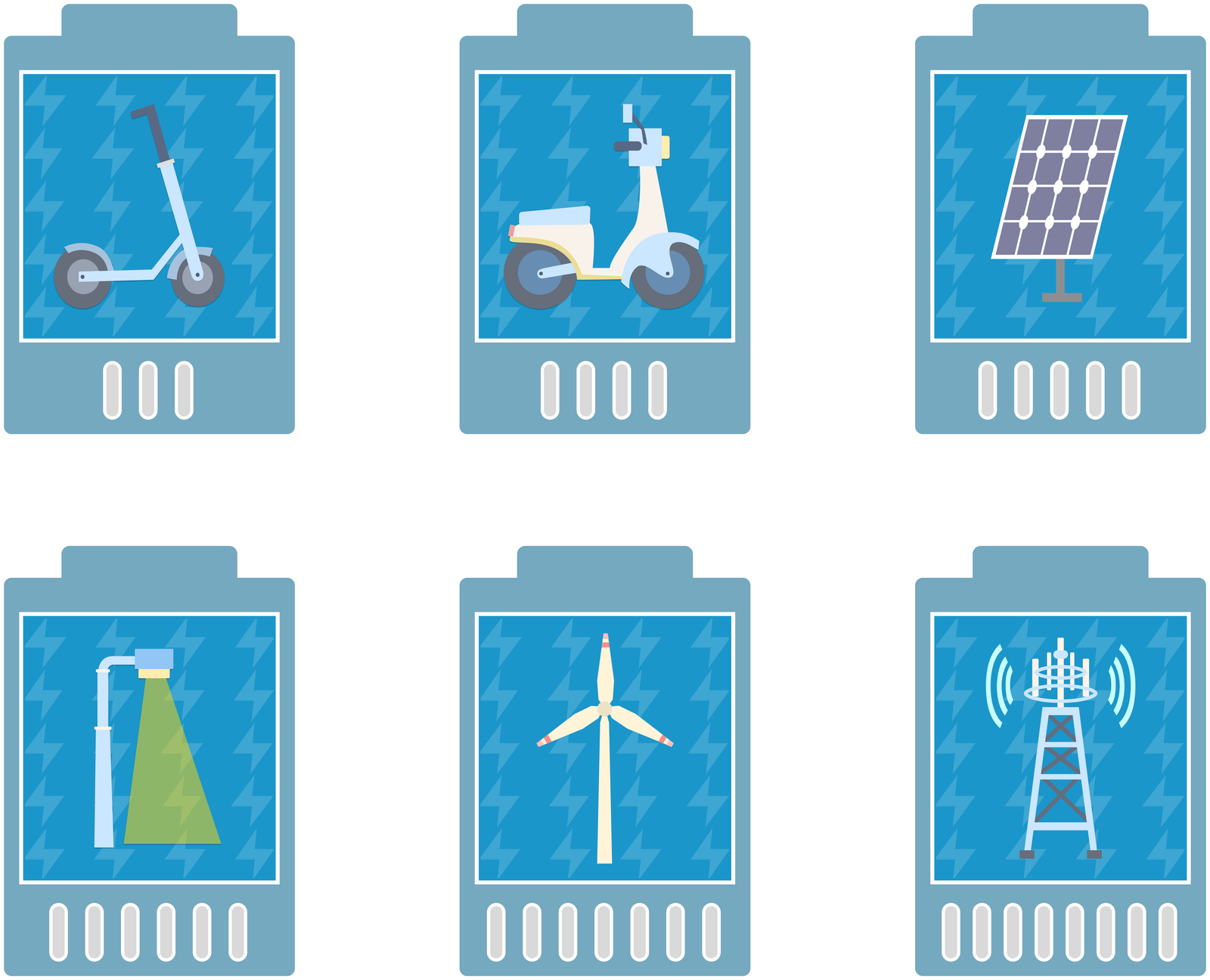
The probabilities for the falling batteries are as follows:
Visual & Audio Design


Animations and effects needed in the game:
• Card flip
• Card disappearance
• Car movement
• Coins appearing

Sound effects and music used in the game
• Background music (BGM)
• Selection
• Adding energy
• Energy full
• Card disappears
• Coins appear
Music and sound effect sources: Pixabay
https://pixabay.com/
https://cdn.pixabay.com/download/audio/2022/03/10/audio_34dea802cf.mp3?filename=080949_heavy-machine-gun-50-caliber-39763.mp3https://pixabay.com/
https://cdn.pixabay.com/download/audio/2022/01/18/audio_db5c1c3b61.mp3?filename=game-ui-sounds-14857.mp3https://pixabay.com/
https://cdn.pixabay.com/download/audio/2023/06/11/audio_83516cb9f0.mp3?filename=game-music-loop-15-153386.mp3
Some sound effects were edited using Adobe Audition.
Presentation and feedback
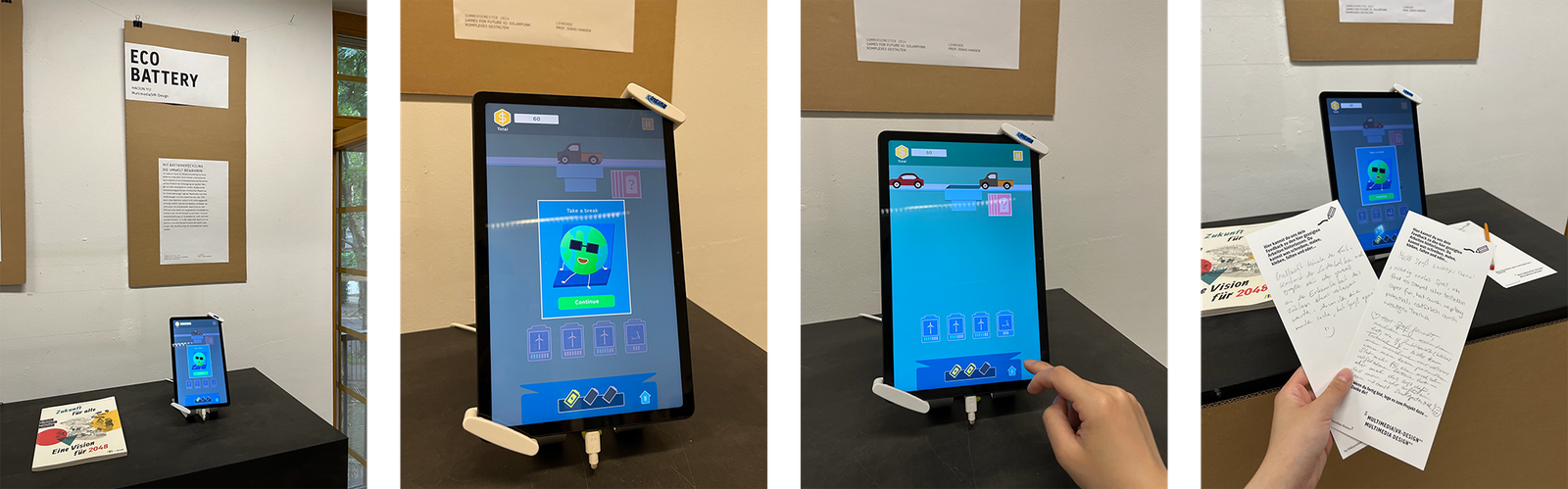
At the Burg2024 annual exhibition, I chose to present my game on an iPad and received thoughtful feedback from the players. They felt that the game deals with a very serious and important topic that deserves attention. At the same time, they really liked the gameplay and found it engaging. Finally, the players pointed out that the game needs a few hints for beginners, which is something that should be improved.
Conclusion
In this “Komplexes Gestalten” course, we discussed and learned a lot about Solarpunk. We were asked to develop games that look towards the future. I am glad I had the opportunity to create a game that addresses a serious topic while still being fun to play. I also hope that my game encourages players to think about the issues it raises. I plan to continue working on the game in my free time and eventually release it on mobile platforms.。