Skip to content

07

Schrödinger’s Cat – A Thought Experiment in Quantum Mechanics

The thought experiment was proposed in 1935 by Erwin Schrödinger to illustrate the superposition of quantum states.

A cat is placed in a closed box together with a radioactive atom.

The atom has a 50% chance of decaying or not decaying.

If it decays, a mechanism is triggered that kills the cat.

According to the Copenhagen interpretation, the atom (and thus the cat) is in a superposition of states – the cat is both alive and dead at the same time, until someone opens the box and “fixes” its state by observing it.

Significance: The experiment illustrates the paradox of quantum mechanics: particles can exist in multiple states at the same time until they are measured.
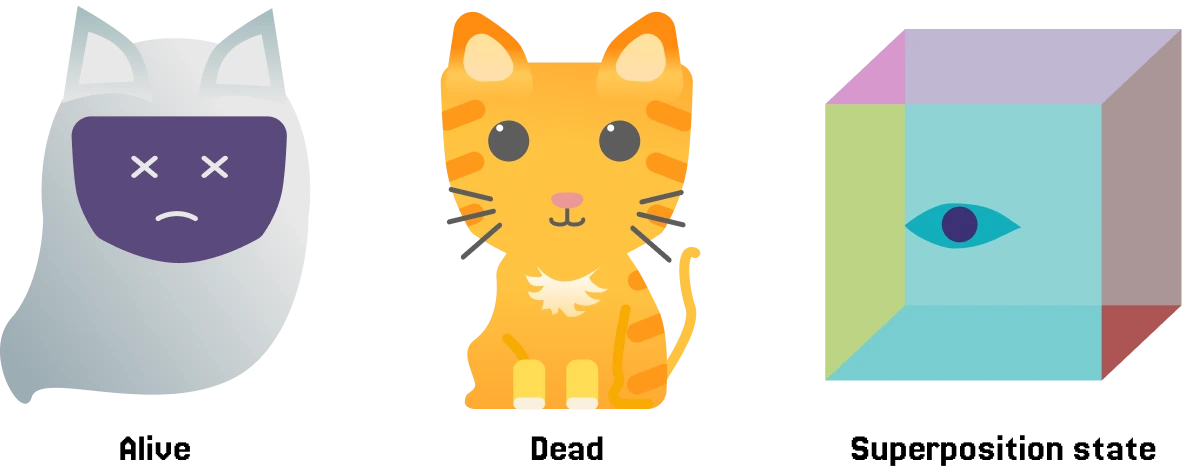
Schrödinger’s cat thought experiment diagram

Before the box is opened, the cat is in a superposition of being both alive and dead; once the box is opened, the cat assumes a definite state (alive or dead). This concept serves as the core source of inspiration for the game’s mechanics and overall design.

09

Game UI & Wireframe

The core goal of the game is to help the player release cats from Schrödinger’s box in different parallel worlds. Each time the box is opened, the cat’s state collapses into either “alive” or “dead”, depending on the random or conditional mechanics defined in the game.

Players tilt their phone to shake the bag inside the box, guiding it as it falls through different universes and triggers events. When a cat survives, a heart icon appears on the screen. By tapping the heart, the player gains energy, which is later used for memory collection.

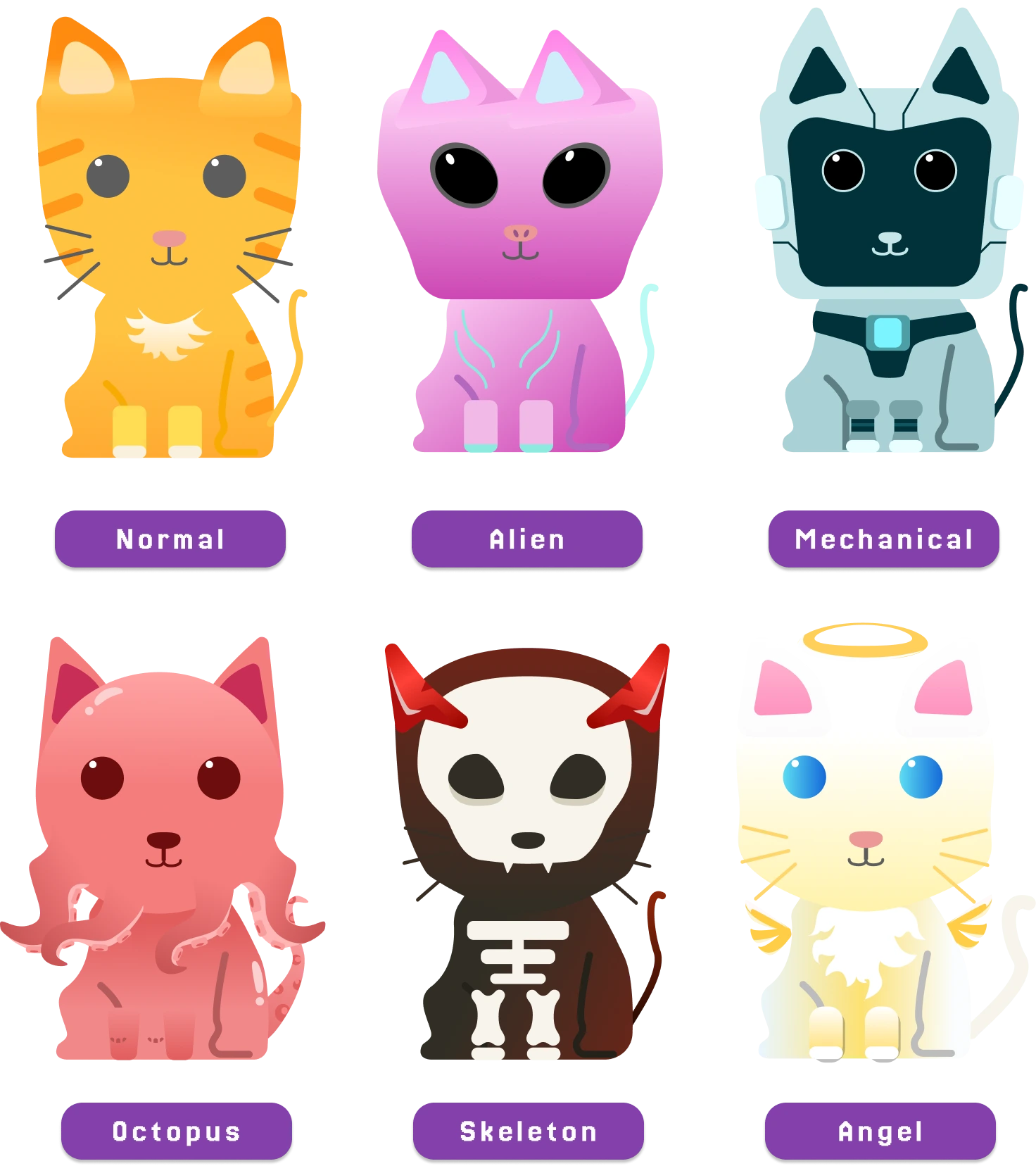
The game is built around a multi-world structure with six distinct universes. In each universe, the cat has its own unique appearance and way of life – for example, in the skeleton world, the cat eats special “bone cookies”. Before being released, every cat appears in an “unknown state”, represented by a question-mark icon. Only after the player successfully interacts with it does the cat’s true state become visible and its icon is updated. This change is directly linked to the unlock conditions of the collection system.
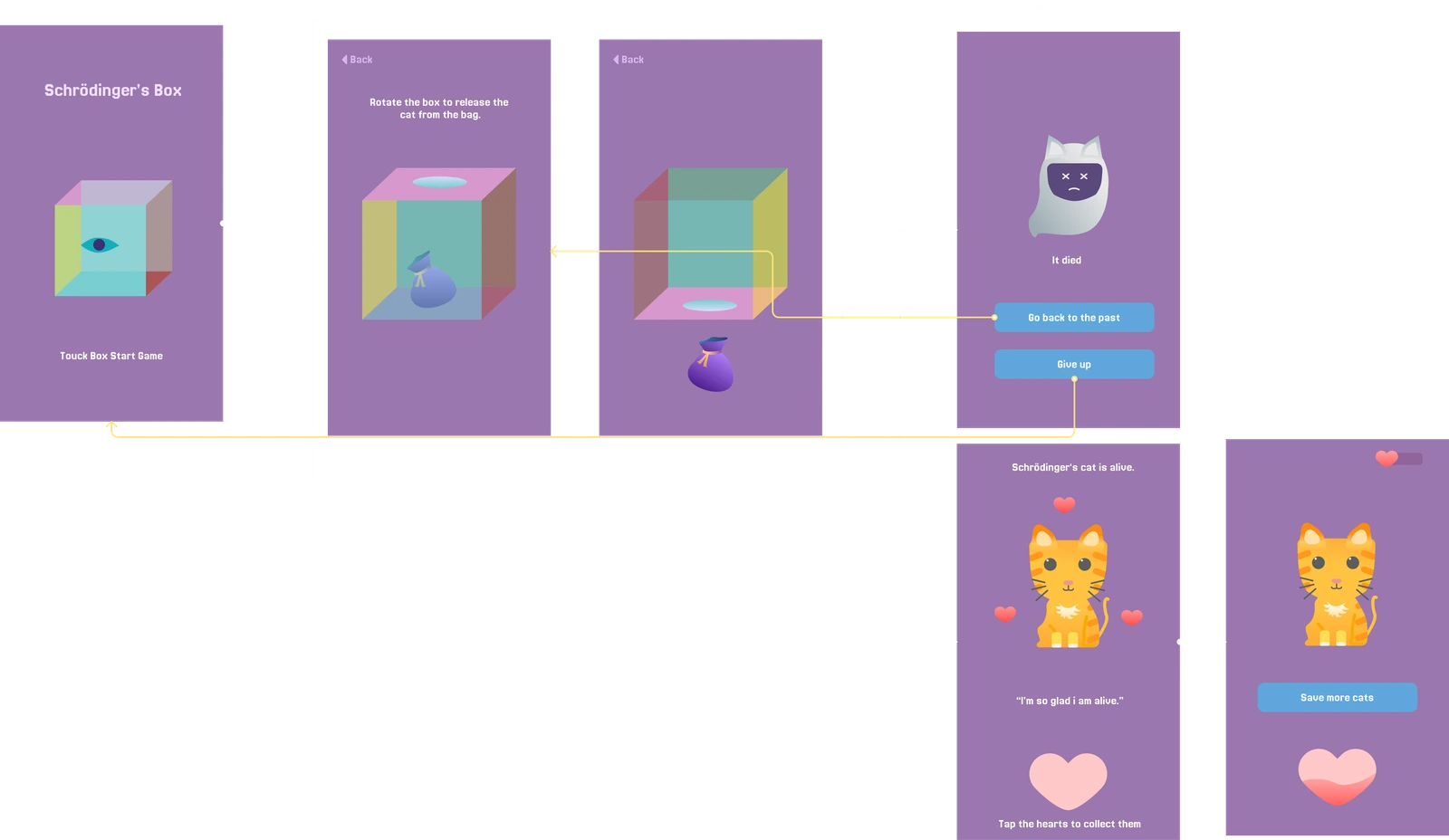
Schrödinger’s Box interface and wireframe overview

The core goal of the game is to help the player release cats from Schrödinger’s box in different parallel worlds. Each time the box is opened, the cat’s state collapses into either “alive” or “dead”, depending on the random or conditional mechanics defined in the game.

Players tilt their phone to shake the bag inside the box, guiding it as it falls through different universes and triggers events. When a cat survives, a heart icon appears on the screen. By tapping the heart, the player gains energy, which is later used for memory collection.

The game is built around a multi-world structure with six distinct universes. In each universe, the cat has its own unique appearance and way of life – for example, in the skeleton world, the cat eats special “bone cookies”. Before being released, every cat appears in an “unknown state”, represented by a question-mark icon. Only after the player successfully interacts with it does the cat’s true state become visible and its icon is updated. This change is directly linked to the unlock conditions of the collection system.
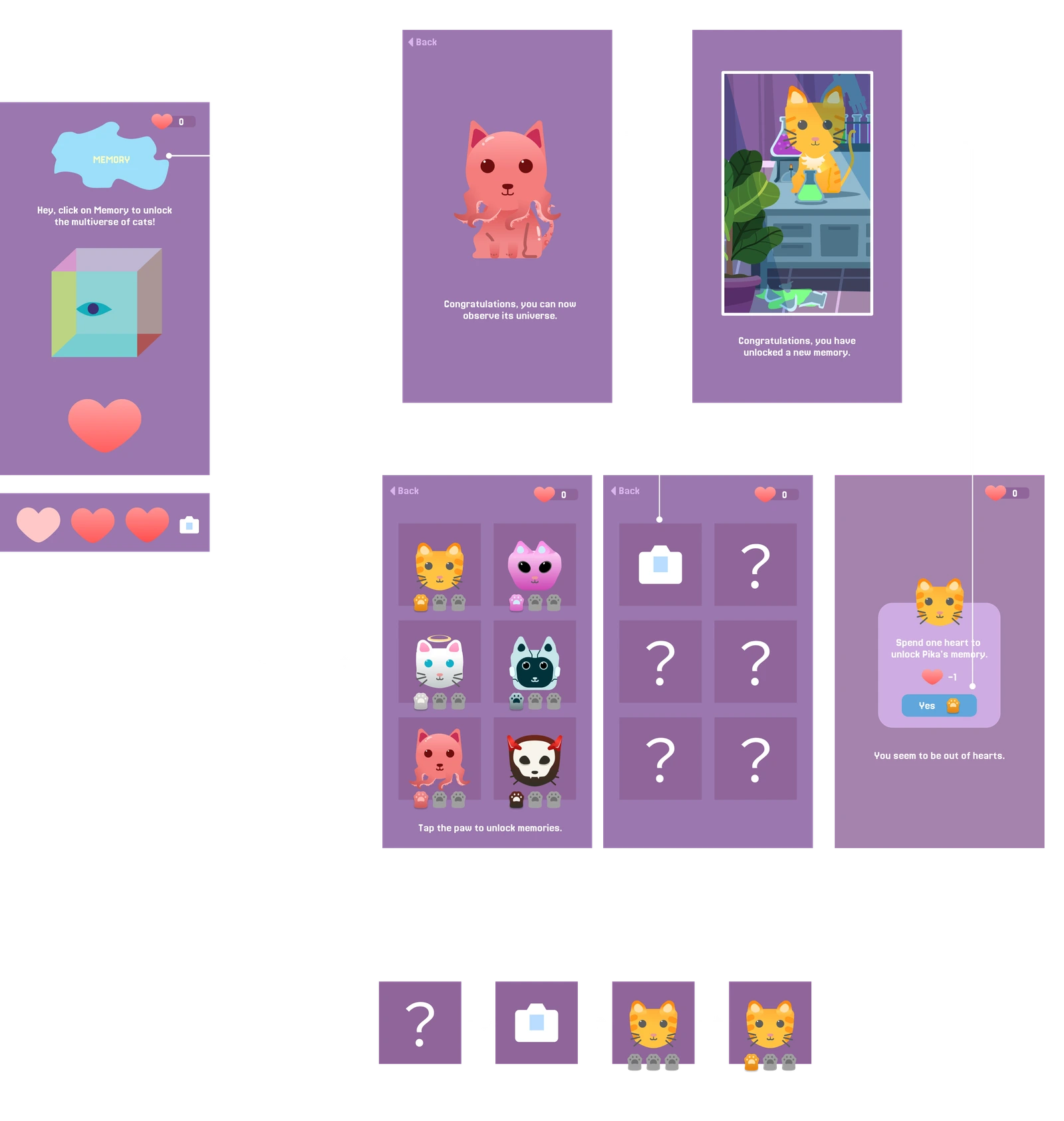
Schrödinger’s Box game interface and memory collection

11

Illustrations

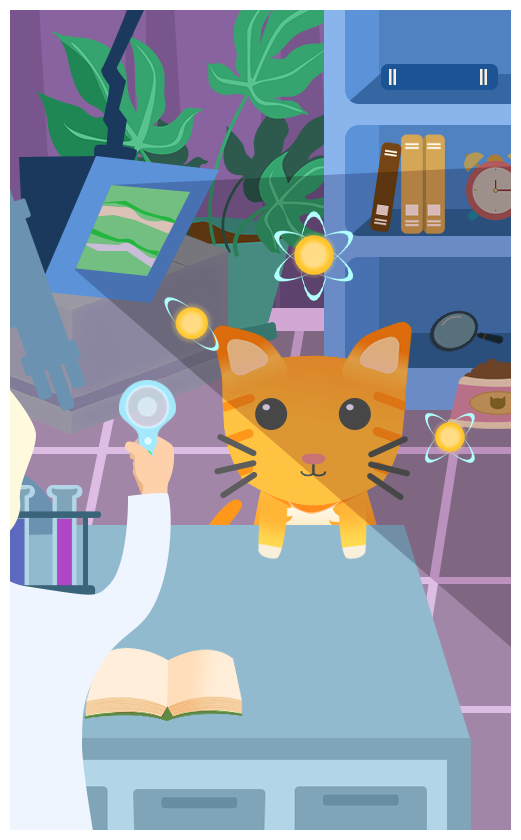
Parallel-world kitten illustration 1
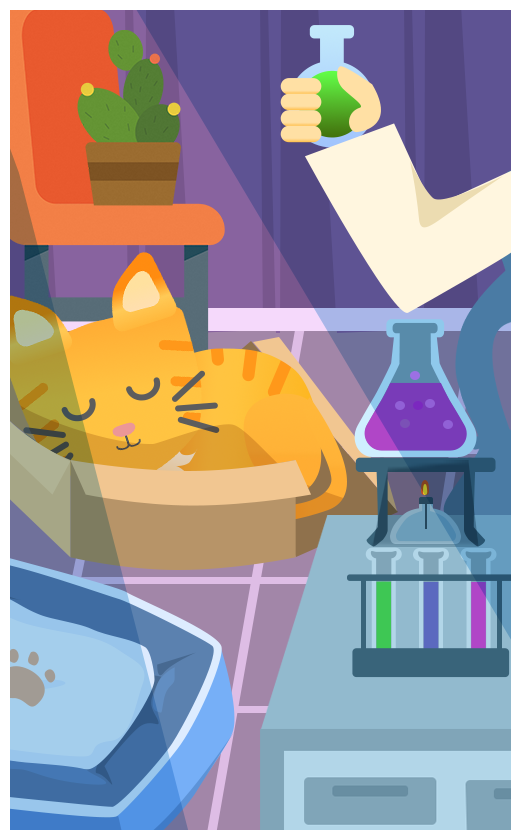
Parallel-world kitten illustration 2
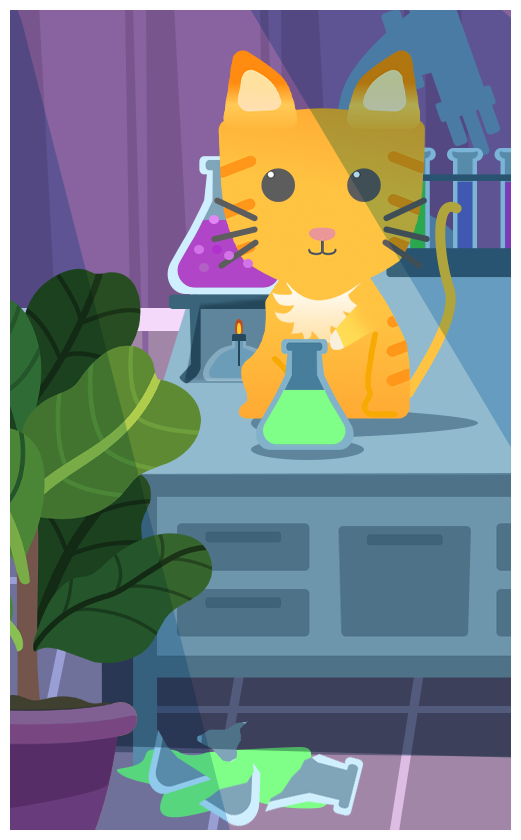
Parallel-world kitten illustration 3
Parallel-world kitten character collection

12

Sound Sources

Click sound effect for the heart: https://pixabay.com/zh/sound-effects/soft-plop-97691/

Sound effect for the heart rising: https://pixabay.com/zh/sound-effects/touching-the-water-176713/

Click sound effect for buttons / game start sound: https://pixabay.com/zh/sound-effects/greanpatch-166007/

Sound effect for unlocking memories: https://pixabay.com/zh/sound-effects/badge-coin-win-14675/

Background music: https://pixabay.com/music/ambient-meditation-stress-reduction-yoga-and-sleep-127566/

13

How I Developed This Game

Prototype design

All core ideas and interface layouts were first explored in Figma, where I created wireflows and interactive prototypes.

Art production 3D models and UI elements such as the box and the bag were modeled in Blender. Illustrations and additional graphic assets were created and refined in Adobe Photoshop.

Audio editing Music and sound effects were primarily sourced from Pixabay. Selected assets were edited and mixed in Adobe Audition.

Game engine & programming The game was developed in Unity. Parts of the programming work were supported by an experienced teammate.

Testing & iteration Throughout development, I continuously tested the game to identify issues and refine the experience. All feedback and bug notes were documented in Figma to support later iterations and improvements.

07

Schrödingers Katze – ein Gedankenexperiment der Quantenmechanik

Das Gedankenexperiment wurde 1935 von Erwin Schrödinger vorgeschlagen, um die Überlagerung von Quantenzuständen zu veranschaulichen.

Eine Katze wird zusammen mit einem radioaktiven Atom in eine geschlossene Box gesetzt.

Das Atom hat eine Wahrscheinlichkeit von 50 %, zu zerfallen beziehungsweise nicht zu zerfallen.

Zerfällt es, wird ein Mechanismus ausgelöst, der die Katze tötet.

Nach der Kopenhagener Interpretation befindet sich das Atom – und damit die Katze – in einer Überlagerung von Zuständen: Die Katze ist gleichzeitig lebendig und tot, bis jemand die Box öffnet und ihren Zustand durch die Beobachtung „festlegt“.

Bedeutung: Das Experiment veranschaulicht das Paradox der Quantenmechanik: Teilchen können bis zu ihrer Messung in mehreren Zuständen zugleich existieren.

Diagramm des Gedankenexperiments Schrödingers Katze

Bevor die Box geöffnet wird, befindet sich die Katze in einer Überlagerung von lebendig und tot. Nach dem Öffnen nimmt sie einen eindeutigen Zustand an: lebendig oder tot. Dieses Konzept ist die zentrale Inspirationsquelle für die Spielmechanik und die gesamte Gestaltung.

09

Spielinterface und Wireframes

Das zentrale Ziel ist es, Katzen in verschiedenen Parallelwelten aus Schrödingers Box zu befreien. Bei jedem Öffnen der Box kollabiert der Zustand der Katze zu „lebendig“ oder „tot“, abhängig von den im Spiel festgelegten Zufalls- oder Bedingungsmechaniken.

Spieler neigen ihr Smartphone, um den Beutel in der Box zu schütteln. So steuern sie seinen Fall durch verschiedene Universen und lösen Ereignisse aus. Überlebt eine Katze, erscheint ein Herzsymbol. Durch Antippen sammeln die Spieler Energie, die später zum Sammeln von Erinnerungen verwendet wird.

Das Spiel besteht aus sechs unterschiedlichen Universen. In jedem hat die Katze ein eigenes Aussehen und eine eigene Lebensweise – in der Skelettwelt frisst sie beispielsweise besondere „Knochenkekse“. Vor ihrer Befreiung befindet sich jede Katze in einem „unbekannten Zustand“, dargestellt durch ein Fragezeichen. Erst nach einer erfolgreichen Interaktion wird ihr wahrer Zustand sichtbar und das Symbol aktualisiert. Diese Änderung ist direkt mit den Freischaltbedingungen des Sammlungssystems verknüpft.

Interface- und Wireframeübersicht von Schrödingers Box

Das zentrale Ziel ist es, Katzen in verschiedenen Parallelwelten aus Schrödingers Box zu befreien. Bei jedem Öffnen der Box kollabiert der Zustand der Katze zu „lebendig“ oder „tot“, abhängig von den im Spiel festgelegten Zufalls- oder Bedingungsmechaniken.

Spieler neigen ihr Smartphone, um den Beutel in der Box zu schütteln. So steuern sie seinen Fall durch verschiedene Universen und lösen Ereignisse aus. Überlebt eine Katze, erscheint ein Herzsymbol. Durch Antippen sammeln die Spieler Energie, die später zum Sammeln von Erinnerungen verwendet wird.

Das Spiel besteht aus sechs unterschiedlichen Universen. In jedem hat die Katze ein eigenes Aussehen und eine eigene Lebensweise – in der Skelettwelt frisst sie beispielsweise besondere „Knochenkekse“. Vor ihrer Befreiung befindet sich jede Katze in einem „unbekannten Zustand“, dargestellt durch ein Fragezeichen. Erst nach einer erfolgreichen Interaktion wird ihr wahrer Zustand sichtbar und das Symbol aktualisiert. Diese Änderung ist direkt mit den Freischaltbedingungen des Sammlungssystems verknüpft.

Spielinterface und Erinnerungssammlung in Schrödingers Box

11

Illustrationen

Illustration eines Parallelwelt-Kätzchens 1
Illustration eines Parallelwelt-Kätzchens 2
Illustration eines Parallelwelt-Kätzchens 3
Sammlung der Kätzchen aus Parallelwelten

12

Audioquellen

Klickgeräusch für das Herz: https://pixabay.com/zh/sound-effects/soft-plop-97691/

Geräusch für das aufsteigende Herz: https://pixabay.com/zh/sound-effects/touching-the-water-176713/

Klickgeräusch für Schaltflächen / Ton beim Spielstart: https://pixabay.com/zh/sound-effects/greanpatch-166007/

Geräusch beim Freischalten von Erinnerungen: https://pixabay.com/zh/sound-effects/badge-coin-win-14675/

Hintergrundmusik: https://pixabay.com/music/ambient-meditation-stress-reduction-yoga-and-sleep-127566/

13

So habe ich das Spiel entwickelt

Prototypgestaltung

Alle grundlegenden Ideen und Interfacelayouts wurden zuerst in Figma untersucht. Dort erstellte ich Wireflows und interaktive Prototypen.

Grafikproduktion 3D-Modelle und UI-Elemente wie Box und Beutel wurden in Blender modelliert. Illustrationen und weitere grafische Assets wurden in Adobe Photoshop erstellt und verfeinert.

Audiobearbeitung Musik und Soundeffekte stammen überwiegend von Pixabay. Ausgewählte Dateien wurden in Adobe Audition bearbeitet und gemischt.

Game Engine und Programmierung Das Spiel wurde in Unity entwickelt. Teile der Programmierung wurden von einem erfahrenen Teammitglied unterstützt.

Tests und Iteration Während der Entwicklung testete ich das Spiel fortlaufend, um Probleme zu erkennen und das Erlebnis zu verbessern. Sämtliches Feedback und Fehlernotizen wurden in Figma dokumentiert, um spätere Überarbeitungen und Verbesserungen zu unterstützen.

07

薛定谔的猫——量子力学思想实验

这个思想实验由埃尔温·薛定谔于 1935 年提出,用于说明量子态的叠加。

将一只猫和一个放射性原子一起放进封闭的盒子。

这个原子有 50% 的概率发生衰变,也有 50% 的概率不发生衰变。

如果发生衰变,就会触发一个导致猫死亡的装置。

按照哥本哈根诠释,原子(以及与之关联的猫)处于状态叠加中:在有人打开盒子、通过观察“确定”其状态之前,猫同时处于活着和死亡的状态。

意义: 这个实验揭示了量子力学的悖论:在被测量之前,粒子可以同时存在于多个状态。

薛定谔的猫思想实验示意图

打开盒子前,猫处于既生又死的叠加状态;打开后,猫才呈现确定的状态(存活或死亡)。这一概念是游戏机制与整体设计的核心灵感来源。

09

游戏界面与线框图

游戏的核心目标是帮助玩家从不同平行世界的薛定谔盒子中释放小猫。每次打开盒子,小猫的状态都会根据游戏中的随机或条件机制坍缩为“存活”或“死亡”。

玩家倾斜手机来摇动盒子中的袋子,引导它穿过不同宇宙并触发事件。小猫存活后,屏幕会出现爱心图标。点击爱心可以获得能量,随后用于收集记忆。

游戏包含六个不同的宇宙。在每个宇宙中,小猫都有独特的外观和生活方式,例如骷髅世界中的小猫会吃特殊的“骨头饼干”。释放之前,所有小猫都处于以问号图标表示的“未知状态”。只有玩家成功与之互动后,小猫的真实状态才会显现,图标也会更新。这一变化与收集系统的解锁条件直接关联。

薛定谔的盒子界面与线框图总览

游戏的核心目标是帮助玩家从不同平行世界的薛定谔盒子中释放小猫。每次打开盒子,小猫的状态都会根据游戏中的随机或条件机制坍缩为“存活”或“死亡”。

玩家倾斜手机来摇动盒子中的袋子,引导它穿过不同宇宙并触发事件。小猫存活后,屏幕会出现爱心图标。点击爱心可以获得能量,随后用于收集记忆。

游戏包含六个不同的宇宙。在每个宇宙中,小猫都有独特的外观和生活方式,例如骷髅世界中的小猫会吃特殊的“骨头饼干”。释放之前,所有小猫都处于以问号图标表示的“未知状态”。只有玩家成功与之互动后,小猫的真实状态才会显现,图标也会更新。这一变化与收集系统的解锁条件直接关联。

薛定谔的盒子游戏界面与记忆收集

11

插画

平行世界小猫插画 1
平行世界小猫插画 2
平行世界小猫插画 3
平行世界小猫角色合集

12

声音来源

点击爱心音效: https://pixabay.com/zh/sound-effects/soft-plop-97691/

爱心上升音效: https://pixabay.com/zh/sound-effects/touching-the-water-176713/

按钮点击/游戏开始音效: https://pixabay.com/zh/sound-effects/greanpatch-166007/

解锁记忆音效: https://pixabay.com/zh/sound-effects/badge-coin-win-14675/

背景音乐: https://pixabay.com/music/ambient-meditation-stress-reduction-yoga-and-sleep-127566/

13

游戏开发过程

原型设计

所有核心创意和界面布局首先在 Figma 中探索,并制作了线框流程与交互原型。

美术制作 盒子、袋子等 3D 模型与界面元素在 Blender 中建模。 插画和其他平面素材在 Adobe Photoshop 中制作与完善。

音频编辑 音乐和音效主要来自 Pixabay。选定素材在 Adobe Audition 中进行编辑和混音。

引擎与编程 游戏使用 Unity 开发,部分编程工作由一名有经验的队友协助完成。

测试与迭代 开发期间持续测试游戏,发现问题并优化体验。所有反馈和缺陷记录均整理在 Figma 中,以支持后续迭代和改进。